Stay informed about conference updates and other LPPDE opportunites by joining our email newsletter and follow up on LinkedIn.
We welcome full-time academic students and faculty to participate in the conference.
Reach out to us to get a 50% discount.
Reach out to us about other discount offers for groups and special guests.
LPPDE Europe 2026 - Helsinki
April 27–30, 2026

In partnership with:

The Art of the Beginning
LPPDE Europe 2026 in Helsinki is approaching!
Dear participant!
Product developers know how one right or one unfortunate decision can change everything. And as a consequence, the product development based on that decision undergoes two very different paths.
It is well known 80–90% of a product’s life cycle profit is determined by the first important decisions. The early part of the journey shapes lasting success. Key making decisions based on knowledge.
On a bright path, we master the beginning. Our product is built on what customer's and end user's true needs, simple, reliable and meaningful. The teams connect to their mission. They focus on their customers, explore and learn, and make their own plans to shorten time to market. Deadlines are met and quality shines. Management stands behind and supports the teams all the way. When we launch, customers line up.
On the contrary, on a hard path. We start to execute on a decent idea we have. The requirements specification is expected to give customers and end users a desirable product. It looks good at the beginning. But based on late customer feedback, teams are forced to change direction halfway through. Deadlines slip, teams are squeezed and energy wanes. When the product is launched late, it is not the breakthrough they hoped for. It's late to market and not quite in line with customer needs.
Whether you’re fired up or feeling at a loss, please come join us in April in Helsinki, Finland, as we persevere toward ways to master The Art of the Beginning. Our objective is to make sure you walk away inspired; with a supportive network and some new ideas you can implement right away!
We hope you’ll join us in Helsinki, Finland, April 27–30, 2026!
Christer Lundh
2026 Europe Conference Chair
The slides from most of the presentations will be shared as a pdf after the conference and the speakers are normally very open to answering questions and to continue the EXCHANGE of knowledge.
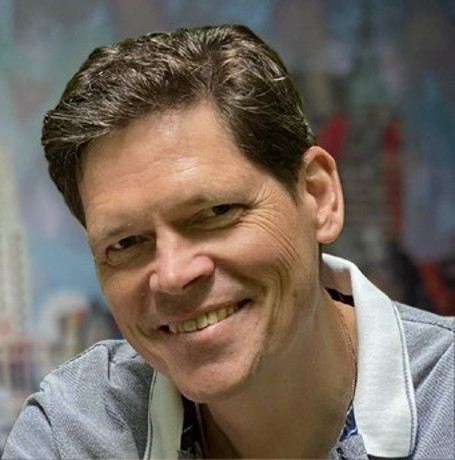
Christer Lundh
Chair of Conference

Bengt Johansson
Co-Chair of Conference
Conference site:
Scandic Park, Mannerheimintie 46, Helsinki, Finland
The program is developed and gets updated continuously.
Monday, April 27, 2026
Pre-Conference Workshops
The organizer
reserves the right to make changes
Workshop Track 1
09:00 - 12:30

Half day workshop (morning):
Lean Product and Process Development Basics
Bengt Johansson and Peter Palmér, LPPDE
This introductory workshop tells the history of LPPD, including a deep dive in some of the models. We will explore the different principles and methods needed to create a well working system for your product development.
- Create usable knowledge
- The role of the chief engineer
- Create teams of responsible experts
- Practice set-based innovation
- Create flow
We will also discuss the similarities and differences with Agile and how to integrate it in the system.
Bengt Johansson has spent his entire working life at ASSA ABLOY and has seen the company grow to a global champion. Bengt has been working around 25 years with product development in different roles, production engineering, through quality management and product development. The latest 15 years Bengt spent in ASSA ABLOYs Lean Innovation program where he has been the Global Lean Innovation Manager the latest 8 years.
Peter Palmér has extensive experience in lean management in both production and product development, as well as experience of leadership in other cultures. With 18 years of experience within production, engineering and quality followed by 20 years in various management positions in product development Peter has many stories to tell. Since the beginning of the 1990es he has been closely involved with the Scania Way development journey both in Sweden and South America.
Peter is a frequent speaker at international and national conferences on the subject of LPD and leadership. Peter has been working closely with LPPDE since the organization's start 2008 including seven years on the LPPDE board with a second period started 2023. Through LPPDE Peter has organized and chaired or co-chaired many conferences in Europe and in the US. Since the end of 2020 he runs the monthly LPPDE Virtual Summits, a three-hour learning exchange with three different speakers. He is a member of various LPD-networks and has co-developed LPD training courses with Chalmers Professional Education and The KTH Royal Institute of Technology.
13:30 - 17:00

Half day workshop (afternoon):
Mastering the Beginning: Integrating the Lean System of Decision-Making with Trade-Off Curves to Improve Early Decisions in Complex System Design
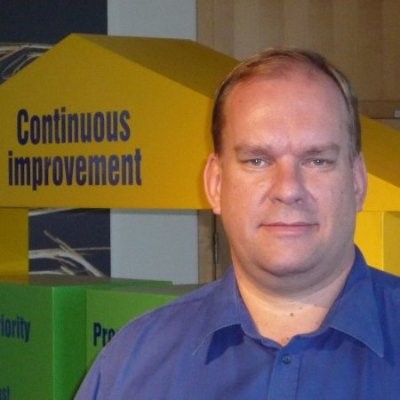
Anand Nicodemus, Jayne Nichols and Dantar Oosterwal, Global Director, Lean & CI + Lean Coach & Director, Engineering + Driving Growth and Transformation, LPD, R&D & Innovation Systems and Author at Fluor
We will bring clarity to the so called fuzzy front-end and how to analyze different options early in a fact based way. Including the lean system for decision making, as well as using trade-off curves to visualize the knowledge and decisions consequences.
The main focus will be on:
• Optimizing technical decisions across multiple variables
• Leveraging understanding across multi-disciplinary teams
Anand Nicodemus is currently the Global Director for Lean within a Fortune 500 integrated Engineering , Fabrication and Construction Company , tasked with building it worldwide lean capacity and capability; and guiding its application of lean for Transformation . He is also the Lean Sensei of Lean Practitioners Canada a not-for-profit Lean advocacy, coaching and practice organization - the first of its kind in Canada. Anand is a Professional Engineer from Alberta and a Lean Sensei, with demonstrated success of application of Lean Thinking and Management in over 80 organizations across 12 countries in improving their Strategy and Operational Performance. As Head of Business Excellence for one of the largest Crown Corporations in the World, Anand set up and operated a Strategy & Continuous Improvement System that spanned 22 Business Units, and generated financial benefits of over a billion in a 5 year period and an Annual Recurring Benefit 20 times the operating budget for Business Excellence He advocates the idea that transformation is possible when an enterprise operates as a "community", for which he has developed an “execution model”, with a set of powerful enablers from the world of Lean Culture. This is a human-centered approach with a higher probability of success.
Jayne Nichols has a long career at Fluor Canada working as a mechanical engineer and lean coach supporting the way of working improving the lean thinking and execution capabilities of industrial capital project teams – spanning front line to senior leadership levels. She has built lean capabilities on projects with complex technical elements, large number of design and construction partners, and distributed execution across the globe. Her special skills include coaching and mentoring the development of the following competencies; lean design, target value design / set based concurrent engineering / set based design, standard work in a design / engineering environment, visible and reusable knowledge, visual management and more.
Dantar Oosterwal is a highly regarded as a global thought-leader in Lean Innovation & Product Development systems as well as an advisor, speaker and award-winning author. He has a passion for learning and applying lean product development systems to impact improvements of business performance. Dantar has championed many large and global operational improvement initiatives as well as developed and led Lean Innovation transformations for organizations resulting in profound improvements to both top-line revenue and bottom-line efficiency.
He has been awarded the Shingo Prize for his work in Lean Innovation by the Shingo Institute, the Outstanding Corporate Innovator award from PDMA and several product patents. Dantar has served as the Global Vice President of Innovation at Sara Lee and Product Development & Product Planning Leader at Harley-Davidson Motor Company. His consulting experience spans a diversity of industries ranging from raw materials (mining and chemicals) to high-tech defense systems.
Workshop Track 2
09:00–17:00
Full day workshop:
MobAI: Co-Intelligence at Work - AI and Humans Solving Problems and Innovating Together
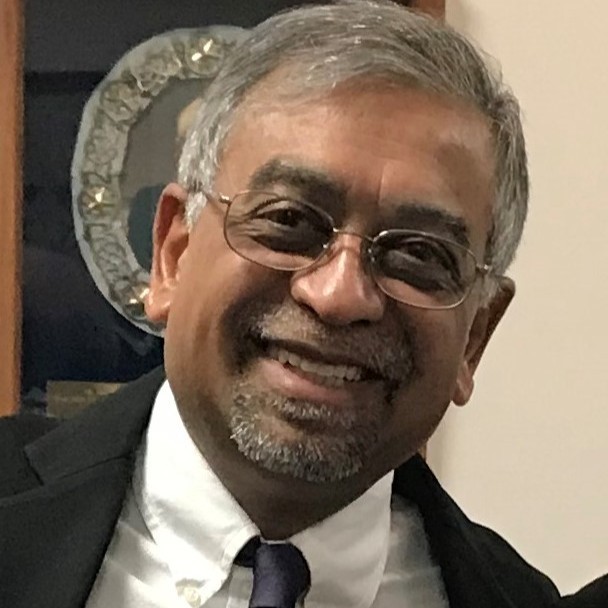
Maarit Laanti and Kimmo Vättö, CEO and partner, transformation coach and trainer + partner, organizational coach at WikiAgile
In this one-day hands-on workshop, you will explore how AI enhances teamwork, problem-solving, and innovation. Through practical exercises and AI-driven collaboration, you’ll gain insight into AI fundamentals, MobAI’s dynamic approach, and essential soft skills for high-performing teams.
This workshop is designed for professionals across industries who want to understand AI’s role in modern work and develop practical strategies for integrating AI into their daily workflows—no prior AI experience required.
Workshop Content
🔹 Understanding AI & Machine Learning
Get a clear introduction to AI fundamentals, how it supports teamwork, and key technologies shaping today’s workplaces.
🔹 MobAI – A Smarter Way to Work
Experience AI-powered collaboration through rapid, structured teamwork cycles. Learn how AI and human intelligence together can accelerate problem-solving and drive innovation.
🔹 High-Performing Teams & Soft Skills
Develop key team dynamics, including trust, psychological safety, and effective communication, to enable AI-augmented collaboration.
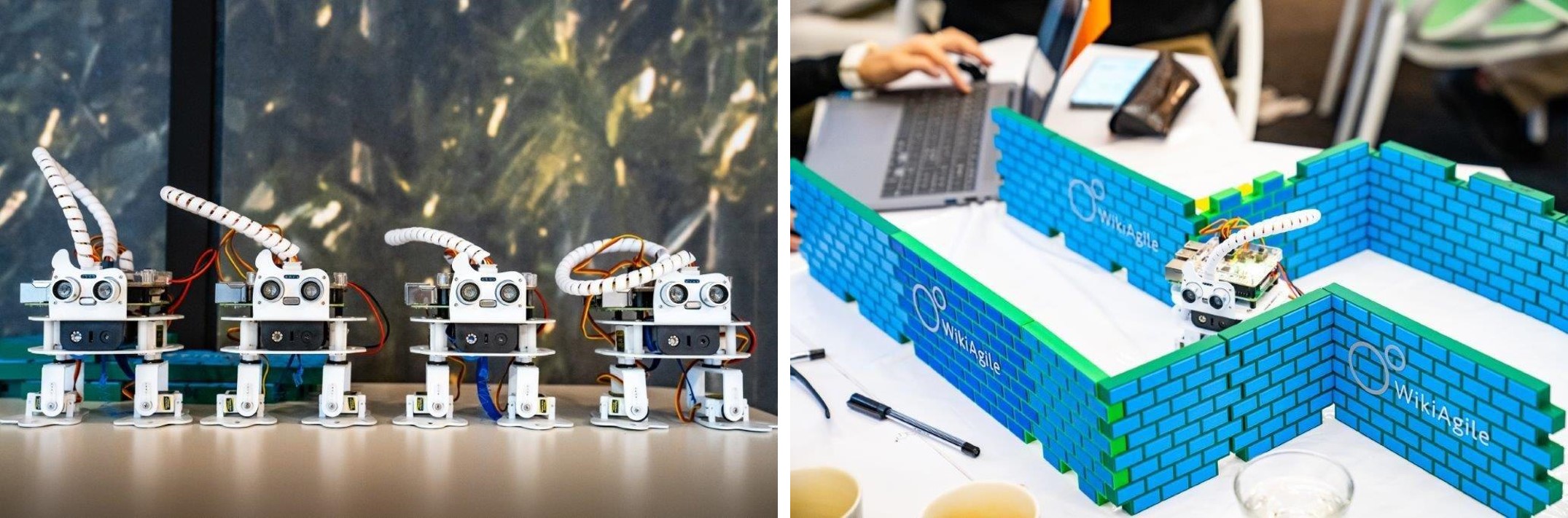
🔹 Solve the Maze – AI-Powered Team Exercise
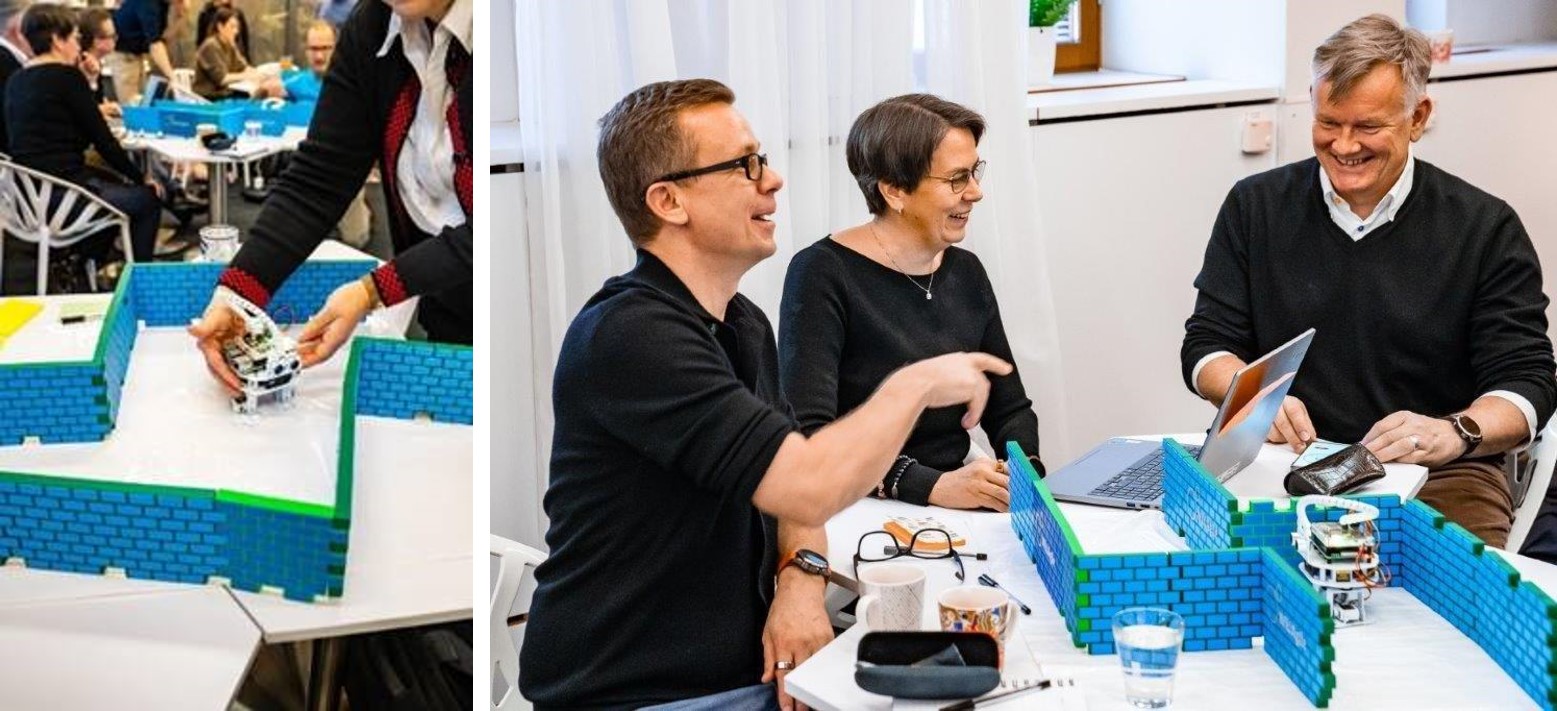
Use AI and robotics to navigate a maze in a hands-on challenge designed to strengthen collaboration, adaptability, and AI-assisted problem-solving. No programming experience is needed—learning happens through experimentation and teamwork.
🔹 Action Planning – Bringing AI into Your Work
Define practical next steps for integrating AI into your daily work. Identify use cases and create an action plan for AI-powered innovation and productivity.
Key Benefits
✅ Hands-On AI Learning – Gain practical AI experience through interactive exercises and real-world applications.
✅ Smarter, Faster Innovation – Learn how AI can enhance problem-solving, creativity, and experimentation.
✅ Stronger Collaboration – Build skills in psychological safety, adaptability, and communication to work effectively with AI.
✅ Actionable Strategies – Leave with clear, practical steps to implement AI-powered teamwork and innovation in your organization.
Conclusion
This workshop is not just about learning what AI can do—it’s about experiencing it in action. Discover how AI can enhance creativity, accelerate problem-solving, and unlock new ways of working, helping you stay ahead in an increasingly AI-driven world.
How can teams achieve tangible results quickly while simultaneously learning new skills? The MobAI workshop combines teamwork, continuous learning, and a model inspired by Tesla’s groundbreaking practices. This workshop challenges conventional thinking, teaches adaptability in fast-changing environments, and provides a practical way to develop new capabilities.
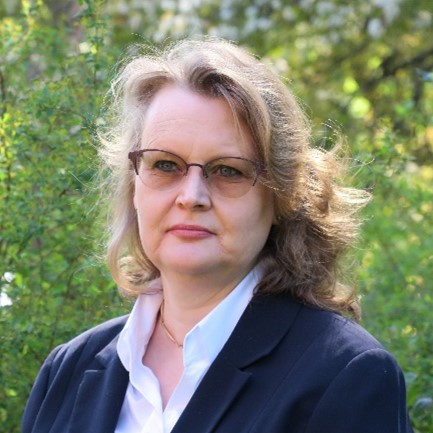
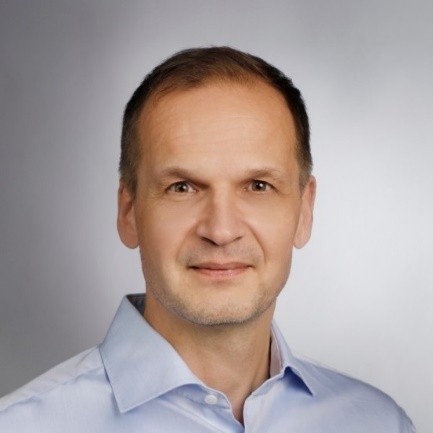
Maarit Laanti I help my clients with AI and Lean-Agile transformations. With extensive expertise in Agile Portfolio Management and Lean practices, our mission is to enable sustainable and impactful transformations. By leveraging collaborative approaches, I help organizations navigate complexity and achieve strategic objectives. As a Partner at WikiAgile, I provide training and consulting services, specializing in enterprise-level transformations. Recognized as a SAFe Fellow, one of the most prestigious distinctions in the agile community, I work to empower that drive efficiency, adaptability, and innovation at scale.
Kimmo Vättö is an energetic change professional with a strong focus on AI-driven transformation. His work increasingly centers on helping individuals and teams adopt AI tools, enhance their decision-making, and build practical, confidence-boosting AI capabilities into their everyday workflows. He frequently designs and coach new AI-enabled ways of working, combining agile and lean thinking with modern, human-centric change practices. Kimmo thrives in diverse teams where we creatively solve challenges on the way to shared success. His background spans leadership roles in international corporate environments and hands-on positions in the startup world, giving me a broad perspective on how organizations can leverage AI to accelerate real impact.
12:30–13:30
Lunch

13:30–17:00
Full day workshop – Mob AI – Continues.
Tuesday, April 28, 2026 Conference Day
The Art of the Beginning
08:30
Summit Welcome
Christer Lundh, Conference chair, LPPDE
Christer Lundh will open the day with his vision for the conference theme:
The Art of the Beginning
and how this affects the managers, the product owners and the engineers, creating a win-win for all involved.
He will also empathize the focus on learning EXCHANGE during the conference.
During the conference we will listen practitioners from established companies, speakers with deep knowledge touching the latest findings in their companies as well as from universities.
As usual we will have a lot of time for knowledge exchange with participants and speakers during the conference.
During lunch we will have open space to be able to discuss relevant topics for you.
09:00
Keynote:
Why Rapid Learning Cycles Makes LPPD Practices Stick
Katherine Radeka, Rapid Learning Cycles Institute
The Rapid Learning Cycles framework for innovation is a repeatable process for using lean practices in early development to eliminate product development waste from idea to launch. In this session, Katherine Radeka will share the specific design choices that make the framework easy to adopt, easy to use, and easy to share, and how you can use these ideas to strengthen your own approach to LPPD to make it easier to embrace.
“Once you know how to see Key Decisions, you can’t unsee them.”
Malte Seidler, Hilti Deutschland, Germany
The Rapid Learning Cycles framework for innovation synthesizes practices from Lean and Agile into a repeatable process for identifying a project’s most important decisions and then structuring the work to make those decisions at the right time, with the right people and the best available knowledge. Along the way, they use practices familiar to people who follow LPPD: good problem-solving with A3s, set-based concurrent engineering, reusable knowledge capture and knowledge-based decision-making. They eliminate the wastes,
Main Takeaways:
- The metrics we use to measure RLC performance and how that drives adoption across a PD organization.
- The intentional design choices that make RLC easy to use — and hard to stop using — so that it sticks.
- How the RLC implementation strategy defuses resistance and turns skeptics into allies to generate organic adoption.
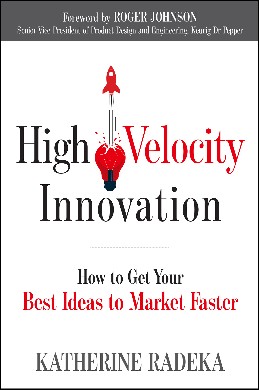
Katherine Radeka empowers organizations developing physical products to 𝗱𝗲𝗹𝗶𝘃𝗲𝗿 𝘁𝗵𝗲 𝗿𝗶𝗴𝗵𝘁 𝗽𝗿𝗼𝗱𝘂𝗰𝘁𝘀 𝗳𝗮𝘀𝘁𝗲𝗿. At the helm of the Rapid Learning Cycles Institute, she leads the charge in revolutionizing innovation management with our proprietary framework, proven to slash time-to-market by 50% or more, and double the ROI from investments in innovation by eliminating project delays and cost overruns at their source.
𝗦𝗲𝗮𝘀𝗼𝗻𝗲𝗱 𝗜𝗻𝗻𝗼𝘃𝗮𝘁𝗼𝗿: From her first high school job crafting a research database at Baylor College of Medicine to decades of experience as a product generation consultant, her career has been a testament to innovative thinking. This extensive experience has grounded her understanding of the nuanced needs of physical product development teams and their leaders.
𝗥𝗮𝗽𝗶𝗱 𝗟𝗲𝗮𝗿𝗻𝗶𝗻𝗴 𝗖𝘆𝗰𝗹𝗲𝘀 𝗙𝗿𝗮𝗺𝗲𝘄𝗼𝗿𝗸 𝗕𝘂𝗶𝗹𝗱𝗲𝗿: Born from the pioneering studies of Dr. Allen Ward on the role of knowledge in product development, this framework applies Agile principles to the challenges of technology research & development to create a robust methodology that accelerates innovation. Companies like Philips, Zeiss, Trimble, Atlas Copco and Breville have leveraged it to cut the time from idea-to-launch for innovation.
𝗣𝘂𝗯𝗹𝗶𝘀𝗵𝗲𝗱 𝗔𝘂𝘁𝗵𝗼𝗿: In her latest book, When Agile Gets Physical, co-authored with Kathy Iberle of HP, they explore the distinct agile practices required by hardware developers compared to software teams. They apply the principles of agile to eliminate the root causes of project delays, cost overruns and disappointing results in physical product developers.
𝗠𝗶𝘀𝘀𝗶𝗼𝗻-𝗖𝗲𝗻𝘁𝗲𝗿𝗲𝗱 𝗗𝗲𝘃𝗲𝗹𝗼𝗽𝗺𝗲𝗻𝘁 𝗔𝗱𝘃𝗼𝗰𝗮𝘁𝗲: She is deeply committed to using technology to combat climate change, address global health concerns and support mission-driven teams solving the world's most important problems. Her collaborations with companies like SunPower/Maxeon in advancing solar technology and aiding Kairos Energy to secure a significant US DOE grant for next-generation nuclear power illustrate her dedication to sustainable innovation.




09:40
Keynote:
How AI is Changing Product Development and Making Agile Product Development a Must
Maarit Laanti, Partner and transformation coach at WikiAgile
Maarit will address how AI is changing product development and making Agile product development (and thus Agile hardware development) a must. She will share her insights from the latest years’ work with applying AI to product development and Agile hardware development.
Maarit Laanti I help my clients with AI and Lean-Agile transformations. With extensive expertise in Agile Portfolio Management and Lean practices, our mission is to enable sustainable and impactful transformations. By leveraging collaborative approaches, I help organizations navigate complexity and achieve strategic objectives. As a Partner at WikiAgile, I provide training and consulting services, specializing in enterprise-level transformations. Recognized as a SAFe Fellow, one of the most prestigious distinctions in the agile community, I work to empower that drive efficiency, adaptability, and innovation at scale.
10:20
Networking Break

10:50
Accelerating Solution Development in A Global Enterprise
Peter Palmér, Senior Strategist and Business Developer at TRATON
How to manage a lean-agile transformation in a culture in a company that is mature and successful and profitable organization. What are the pros- and cons of the current improvement culture when you need to make a transformation into a more effective and efficient way of working? Peter will tell his view of the Scania Way journey improving the way of working within the company from the beginning of 1990 until today and looking towards the future with a more intense transformation, especially when including all four brands of the TRATON family, MAN, Navistar, Scania and VW Truck & Bus.
Peter Palmér has extensive experience in lean management in both production and product development, as well as experience of leadership in other cultures. With 18 years of experience within production, engineering and quality followed by 20 years in various management positions in product development Peter has many stories to tell. Since the beginning of the 1990es he has been closely involved with the Scania Way development journey both in Sweden and South America.
Peter is a frequent speaker at international and national conferences on the subject of LPD and leadership. Peter has been working closely with LPPDE since the organization's start 2008 including seven years on the LPPDE board with a second period started 2023. Through LPPDE Peter has organized and chaired or co-chaired many conferences in Europe and in the US. Since the end of 2020 he runs the monthly LPPDE Virtual Summits, a three-hour learning exchange with three different speakers. He is a member of various LPD-networks and has co-developed LPD training courses with Chalmers Professional Education and The KTH Royal Institute of Technology.

11:30
From Concept to Commitment: Turning Ideas into Customer-Driven Objective
Bengt Johansson, Lean Agile Coach at Lean Peak Solutions
Using a Pretotype Sales Brochures to Define and Test Product Value.
What if your team could know—before building anything—whether customers would actually be excited about your next product? In this hands-on workshop, you’ll learn how to use fake sales brochures as a powerful tool for shaping early product concepts, aligning cross-functional teams, and gathering real feedback from potential customers.
Through practical examples, and small experiments, you’ll experience how this simple technique brings clarity to what really matters: the customer’s problem, the promise you’re making, and the value you need to prove. Perfect for product developers, marketers, designers, and innovation leaders looking to bring Lean thinking to the front end of development.
Bengt Johansson has spent his entire working life at ASSA ABLOY and has seen the company grow to a global champion. Bengt has been working around 25 years with product development in different roles, production engineering, through quality management and product development. The latest 15 years Bengt spent in ASSA ABLOYs Lean Innovation program where he has been the Global Lean Innovation Manager the latest 8 years.
12:00
Networking Lunch – Open Space
13:30
Accelerating Organizational Transformation through Culture Development and Successful Pilots
Henna Torkkola, Agile Lead, Continuous improvement & Planning, R&D and Engineering and Laura Keihänen Program Manager, RDE way, R&D and Engineering, R&D and Engineering at Wärtsilä
Henna and Laura will share their deep experience about how Wärtsilä is shaping the decarbonization of marine and energy, but green is not black or white. There is no single solution that will carry us through this transition, and the journey will take time. The same is true when thinking about how to transform and continuously evolve ways of working — there is no one approach or method that fits all situations, but there are several successful implementations and examples to build on.
In this presentation Henna and Laura will address the topic by sharing how they are building a culture that embraces cross-functional collaboration, early engagement, and a proactive mindset — a culture designed to enable a frontloaded way of working that reacts smoothly and delivers meaningful value to customers in a rapidly changing world. She will also share insights and learnings from a pilot case where a future proof engine was successfully developed by applying agile values.
Henna Torkkola is an enthusiastic agilist with a strongly human centric approach. Since 2018, she has been driving agile transformation in Wärtsilä’s Engines R&D by coaching teams and leaders towards more collaborative, sustainable, and continuously improving ways of working. Henna is passionate about the cultural and psychological aspects of agility and firmly believes that the values behind agile can be successfully applied across diverse development environments—regardless of industry. She also believes that when organizations intentionally cultivate a culture that enables true holistic agility, they unlock the ability to create exceptional value for their customers and, as a result, set the foundation for long term success.
Laura Keihänen is a versatile generalist with a strong interest in research and development. Since participating in an SAP implementation in 2008, she has been passionate about improving ways of working. Laura has several years of experience in B2B sales and engineering, delivering tailor made solutions for complex customer segments such as Marine and Nuclear.In recent years, she has worked in Wärtsilä R&D, focusing on developing the organization through operational excellence and agile ways of working. Most recently, her work has centered on frontloading and artificial intelligence transformation.


14:10
Mastering the Beginning through Early Knowledge-Driven Decisions: Challenges and Solutions in Shaping Lifecycle Profit in Complex Projects
Anand Nicodemus, Jayne Nichols and Dantar Oosterwal, Global Director, Lean & CI + Lean Coach & Director, Engineering + Driving Growth and Transformation, LPD, R&D & Innovation Systems and Author at Fluor
We will bring clarity to the so called fuzzy front-end and how to analyze different options early in projects a fact-based way.
Assuring a lifecycle profit in complex projects.
The main focus will be on:
• Development as a socio-technical endeavor - elevating trust, communication & collaboration
• 80-90% of lifecycle profit is affected early in product development – let’s get it right
Anand Nicodemus is currently the Global Director for Lean within a Fortune 500 integrated Engineering, Fabrication and Construction Company, tasked with building it worldwide lean capacity and capability; and guiding its application of lean for Transformation. He is also the Lean Sensei of Lean Practitioners Canada a not-for-profit Lean advocacy, coaching and practice organization - the first of its kind in Canada. Anand is a Professional Engineer from Alberta and a Lean Sensei, with demonstrated success of application of Lean Thinking and Management in over 80 organizations across 12 countries in improving their Strategy and Operational Performance. As Head of Business Excellence for one of the largest Crown Corporations in the World, Anand set up and operated a Strategy & Continuous Improvement System that spanned 22 Business Units, and generated financial benefits of over a billion in a 5 year period and an Annual Recurring Benefit 20 times the operating budget for Business Excellence He advocates the idea that transformation is possible when an enterprise operates as a "community", for which he has developed an “execution model”, with a set of powerful enablers from the world of Lean Culture. This is a human-centered approach with a higher probability of success.
Jayne Nichols has a long career at Fluor Canada working as a mechanical engineer and lean coach supporting the way of working improving the lean thinking and execution capabilities of industrial capital project teams – spanning front line to senior leadership levels. She has built lean capabilities on projects with complex technical elements, large number of design and construction partners, and distributed execution across the globe. Her special skills include coaching and mentoring the development of the following competencies; lean design, target value design / set based concurrent engineering / set based design, standard work in a design / engineering environment, visible and reusable knowledge, visual management and more.
Dantar Oosterwal is a highly regarded as a global thought-leader in Lean Innovation & Product Development systems as well as an advisor, speaker and award-winning author. He has a passion for learning and applying lean product development systems to impact improvements of business performance. Dantar has championed many large and global operational improvement initiatives as well as developed and led Lean Innovation transformations for organizations resulting in profound improvements to both top-line revenue and bottom-line efficiency.
He has been awarded the Shingo Prize for his work in Lean Innovation by the Shingo Institute, the Outstanding Corporate Innovator award from PDMA and several product patents. Dantar has served as the Global Vice President of Innovation at Sara Lee and Product Development & Product Planning Leader at Harley-Davidson Motor Company. His consulting experience spans a diversity of industries ranging from raw materials (mining and chemicals) to high-tech defense systems.
14:50
Networking Break
15:20
Lead With Strategy: Reducing Delay-of-Surprise in the Liquid Organization
Morten Elvang, Managing Partner at Thinking Twice Works
Most organizations don’t suffer from a lack of strategy - but from truth starvation caused by unnecessarily closed and over-rigid structures. Signals surface too late, known tensions remain unspoken, and conversational debt quietly turns viable options into wasted opportunity.
When complexity dominates, cadence-driven Agile and portfolio rituals become expensive ways of delaying surprise. AI now offers new capabilities and raises a simple question: What would Agile - and the organization itself - look like if AI absorbed most work management and coordination, and leadership focused on strategic judgment and orchestration instead?
Using Cynefin’s solid-liquid-gas lens, I introduce the Liquid Organization and show how selected Cynefin frameworks can be used as a practical test of strategy - stress-testing risk balance, coherence, and challenge-intervention fit.
AI marks a structural shift in how work is coordinated. Some talk of an entire new post-industrial era of work - something that cannot be ignored by any organization. Lean and agile principles still apply, but the organizational context is changing. For large organizations, this is about competitiveness. For smaller ones, relevance. In both cases, benefiting from AI depends on changing the operating model - not just the tools. Ultimately, it comes down to reducing delay-of-surprise and learning how to navigate tensions in real time. That is what it means to lead with strategy - and the core practice behind liquid agility.
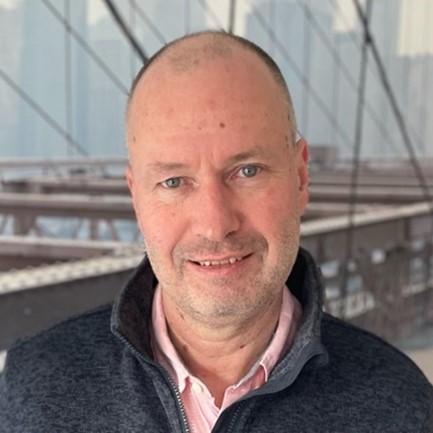
Morten Elvang is an expert in agile and lean for strategy, product, service, and technology delivery. He has worked with platform, product, and service teams of all sizes to gain better results with less hassle - both as a consultant and as an employee. Morten holds an MSc and PhD in Software Engineering and is the author of two contemporary books UNMESS and UNFILTER about Collaborative Lean Portfolio Management and the role it plays in open and adaptable organizations.

16:00
The Art of the Beginning & Agile Culture in Leadership: Accelerating Learning and Impact
Mirette Kangas, Transformation Leader and Facilitator with Hands-On Execution
We believe exceptional outcomes are achievable when teams act with purpose, learn quickly, and possess both the authority and capability to make decisions. In my presentation, Mirette will share her experiences and insights on how adopting an agile mindset and culture can enhance the effectiveness and quality of a leader's work, as well as the sources of rapid learning.
This is a brand-new presentation, based on the theme "The Art of the Beginning.”
Mirette has previously spoken about: “It´s an ultramarathon. 10 key lessons learned about lean-agile transformation as a change leader” and “Transformation Superpowers.”
Mirette Kangas is a recognized leader, advisor, and pioneer in Lean-Agile culture in Finland. Her work has inspired numerous companies across various industries to adopt an agile corporate culture, embrace business agility, and thrive in fast-paced, complex, creative, and innovative environments.
Mirette has served as the Director of Business Excellence at Elisa, the Finnish market leader in telecommunications and digital services. Before that, she was responsible for KONE's global Lean and Agile operating model, a company recognized as a global leader in the elevator and escalator industry. Additionally, she played a pivotal role in developing and promoting an agile culture at Yle, the Finnish National Broadcasting Company, for 15 years. Mirette is also a co-founder of Yle Areena, Finland's leading streaming media service. Her experience includes serving as a production director at Sanoma Group, an innovative and agile learning and media company, and leading numerous projects for Nokia, a global leader in mobile devices and networks at that time.

16:40
Break
17:00
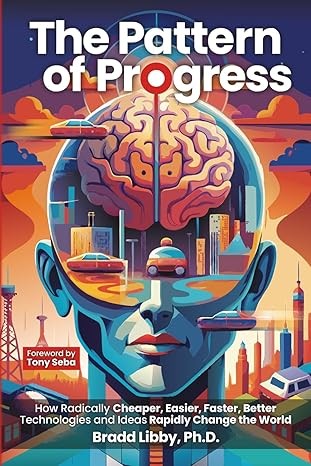
The Pattern of Progress: How Radically Cheaper, Easier, Faster, Better Technologies and Ideas Rapidly Change the World
Bradd Libby, Responsible for our complex systems analysis and modelling at Rethink X
The rapid and transformative adoption of new technologies, new ideas, new behaviors, and new business models has followed a repeatable pattern for at least hundreds of years, maybe tens of thousands or millions. It might be a general feature of collective decision-making in many sentient creatures, not just us Homo sapiens. And it is likely to be a key dynamic, if not the key dynamic, that governs whether in the next decades we will produce unparalleled progress and shared prosperity, solving some of our greatest environmental and social challenges if we harness its power well, or whether we will slide into an extended period of stagnation and decline if we do not.
Bradd Libby is responsible for complex systems analysis and modelling at RethinkX, a not-for-profit organization devoted to studying technology-driven disruptions and their consequences. Prior to RethinkX, he spent several years designing and building scientific equipment for use in the Arctic and studying the effects of climate change on industry, agriculture, and cities.
He has been professionally involved in using computer simulation, including system dynamics and Monte Carlo simulation, to understand complex systems for more than two decades. Bradd has a PhD in Chemical Engineering from the University of Massachusetts at Amherst.


17:40
Closing Address
Christer Lundh, Conference chair, LPPDE
What learnings and practices will you be taking back with you to apply on Monday morning?
Back to work:
- Share your learnings
- Run experience
- Learn fast
- Implement
18:00 -
Networking Buffet and Knowledge Exchange


Wednesday, April 29, 2026
Post-Conference Workshops
The organizer
reserves the right to make changes
Workshop Track 1
09:00 - 17:00

Full day workshop:
The Art of the Beginning: Compound Learnings for Breakthrough Starts
Christer Lundh, AUFERO
Unlock Speed of Innovation: Build Knowledge Bottom-Up to Nail Your First Key Decisions in Product Development. Benefits From Exploration, Grow Like Compound Interest.
“Compound interest is the eighth wonder of the world.
He/ she who understands it, earns it… he/ she who doesn’t… pays it”
Quote by Albert Einstein
In this full-day workshop, discover why top-down plans often fail new products—and how swift exploration at the beginning builds knowledge bottom-up, and let you thrive on uncertainty.
This helps CTOs, R&D Directors, Product Owners and Project Leaders who answers YES to one or more of below three questions:
-
- Have you thought in the last year that next time, for the next product development, we should not be late? This time we should do better, now we should do it right.
- Have you repeatedly reflected on your product development, why your teams discover the real problems so late? Having a desire for next time, your teams to explore and robustly solve these problems from day 1?
- Counting the number of completed development projects. A smaller fraction has been completed ahead of or within either schedule or budget. And met or exceeded customer expectations and user experiences?
Then join this worksop on how to shape early development decisions that reduce delays and accelerate time-to-market. Led by 25 years of senior leadership practice.
Seven principles you will apply:
-
- Convexity over knowledge: make design decisions where upside dominates downside; outcomes matter more than predictive understanding of complex systems.
- Favor optionality, also known as Set-Based Design: create multiple low-cost paths and choices instead of committing early to single, high-risk development trajectories.
- Trials with small harmless errors over theory: prioritize fast experimentation cycles; real-world feedback beats analytical models in uncertain environments.
- Small bets, big upside: structure initiatives so failures are limited and errors are small, harmless but contains valuable knowledge, while successful outcomes scale significantly.
- Avoid fragile optimization: don’t over-engineer early; preserve flexibility to adapt as new knowledge are built.
- Focus on payoffs, not forecasts: evaluate decisions by asymmetry of results, not accuracy of predictions.
- Embrace volatility: build processes that improve through stress, variability, and change instead of resisting them.
Leave after this workshop with actionable methods to start right—and finish faster.
Christer Lundh is president of AUFERO, a consultant firm that helps senior leaders and development teams to benefit from small low-cost iterations that remove a lot of risk. Christer has built his expertise from extensive practice. He provides transformations, strategic projects and personal advice, within product flow management, advisor on leadership, and interim senior manager. He is a board member at LPPDE.org. He is a passionate leader who creates flow of new products and innovations together with customers.
Wednesday and Thursday, April 29–30, 2026
Post-Conference 2-day Workshop
Link:
Discounts available for those who register on both the conference and this workshop.
Workshop Track 2
Wednesday 09:00 - 17:00, Thursday 09:00 - 17:00
Two full days:
Rapid Learning Cycles Global Project Leader
Certification Workshop
Katherine Radeka, Rapid Learning Cycles Institute
This experience will prepare you to run a small to medium sized team using Rapid Learning Cycles in the early phases of product development.
You will learn:
- Why and how Rapid Learning Cycles is a proven way to remove rework loops, revisited decisions and late design changes to accelerate time-to-market for physical products.
- How the elements of the framework fit together to build team alignment, engage stakeholders and decision makers, focus the team on its most important work, and pull real-time knowledge capture and sharing.
- The steps of the Kickoff Event that establishes Rapid Learning Cycles for a project team, from the Core Hypothesis to the Learning Cycles Plan.
- How to run Learning Cycle and Integration Events so that they drive better decision making.
- How to integrate execution activities into the Learning Plan without losing the team’s focus on building knowledge first.
The Details
- Two days of live interactive sessions that go deeply into the Rapid Learning Cycles framework from the perspective of the team's leadership.
- Licensed, reusable training materials that you can share with your team to introduce them to the Rapid Learning Cycles framework.
- Unlimited access to our video library covering Rapid Learning Cycles key content, to ensure that you are well prepared to lead your team through the process.
- Over 15 templates and checklists for key preparation and follow-up tasks.
This Course Includes:
- Full access to all online Rapid Learning Cycles Global Project Leader materials for prework that will maximize the value of our time together.
- In person case study to build core skills necessary to succeed with the framework the first time.
- Upon completion of certification, participants gain access to reusable materials for running their own Kickoff Events and use RLC with their own teams.
For more details and registration visit this web page: https://rapidlearningcycles.com/lppde-workshop-helsinki/
Katherine Radeka empowers organizations developing physical products to 𝗱𝗲𝗹𝗶𝘃𝗲𝗿 𝘁𝗵𝗲 𝗿𝗶𝗴𝗵𝘁 𝗽𝗿𝗼𝗱𝘂𝗰𝘁𝘀 𝗳𝗮𝘀𝘁𝗲𝗿. At the helm of the Rapid Learning Cycles Institute, she leads the charge in revolutionizing innovation management with our proprietary framework, proven to slash time-to-market by 50% or more, and double the ROI from investments in innovation by eliminating project delays and cost overruns at their source.
𝗦𝗲𝗮𝘀𝗼𝗻𝗲𝗱 𝗜𝗻𝗻𝗼𝘃𝗮𝘁𝗼𝗿: From her first high school job crafting a research database at Baylor College of Medicine to decades of experience as a product generation consultant, her career has been a testament to innovative thinking. This extensive experience has grounded her understanding of the nuanced needs of physical product development teams and their leaders.
𝗥𝗮𝗽𝗶𝗱 𝗟𝗲𝗮𝗿𝗻𝗶𝗻𝗴 𝗖𝘆𝗰𝗹𝗲𝘀 𝗙𝗿𝗮𝗺𝗲𝘄𝗼𝗿𝗸 𝗕𝘂𝗶𝗹𝗱𝗲𝗿: Born from the pioneering studies of Dr. Allen Ward on the role of knowledge in product development, this framework applies Agile principles to the challenges of technology research & development to create a robust methodology that accelerates innovation. Companies like Philips, Zeiss, Trimble, Atlas Copco and Breville have leveraged it to cut the time from idea-to-launch for innovation.
𝗣𝘂𝗯𝗹𝗶𝘀𝗵𝗲𝗱 𝗔𝘂𝘁𝗵𝗼𝗿: In her latest book, When Agile Gets Physical, co-authored with Kathy Iberle of HP, they explore the distinct agile practices required by hardware developers compared to software teams. They apply the principles of agile to eliminate the root causes of project delays, cost overruns and disappointing results in physical product developers.
𝗠𝗶𝘀𝘀𝗶𝗼𝗻-𝗖𝗲𝗻𝘁𝗲𝗿𝗲𝗱 𝗗𝗲𝘃𝗲𝗹𝗼𝗽𝗺𝗲𝗻𝘁 𝗔𝗱𝘃𝗼𝗰𝗮𝘁𝗲: She is deeply committed to using technology to combat climate change, address global health concerns and support mission-driven teams solving the world's most important problems. Her collaborations with companies like SunPower/Maxeon in advancing solar technology and aiding Kairos Energy to secure a significant US DOE grant for next-generation nuclear power illustrate her dedication to sustainable innovation.
The conference hosts speakers from the following organizations:


Register Now!
LPPDE events have an impressive gathering of lean product and process development practitioners. We’ve assembled an impressive lineup of keynote speakers.