

“Slow is smooth, and smooth is fast” isn’t the motto of the U.S. Navy Seals for frivolous reasons. In battle-tested conditions under extreme conditions, this motto has proved its success many times over by preventing the chaos that can lead to failed missions and disastrous results. And as it turns out, this motto applies to many complex situations, not just military undertakings or wartime engagements under extreme conditions. In fact, it is directly applicable to one area that this community cares deeply about – complex Product Development.
In today’s ultra-competitive marketplace, companies often feel intense pressure to deliver more products to market as fast as possible in order to meet ever-increasing revenue and growth targets. Too often and with best intentions, a company’s predisposition might be to push more and more products into the Product Development pipeline. But this approach often backfires and results in missed milestones, product delays, sub-optimized product quality, and sub-par business performance. It is in time like these that this motto is best applied. “Slow is smooth, and smooth is fast!”
Slow down to speed up?
Admittedly, no CEO or Leadership team wants to hear anything about “slowing down” to solve problems. So, for the purpose of having an effective dialogue, we’ll modify and simplify the motto to just “smooth is fast.” And that’s what this is all about – it’s all about the flow of your Product Development system. If you define the output of your Product Development system as finished, high-quality products to market on-time, and you want to optimize your product development output, the key to success is to focus on understanding, creating, and optimizing the flow in your Product Development system.
There is science behind this statement – this is not just an organization plea to reduce pressure by slowing down. In fact, it’s quite the opposite. It’s to understand that how you load your Product Development system can result in on time, high-quality products, or it can lead to missed deadlines, budget overruns, delays, and unpredictable results. In actuality, loading the Product Development system at the appropriate level can increase speed, and it is imperative on the Leadership team to embrace this principle and study its flow, work to reduce bottlenecks, and take action now to avoid future delays. This also creates the right type of tension within teams, increases the constructiveness of actions, reduces frustrations, increases engagement, and ultimately optimizes output.
Understanding Product Development as a System
The best analogy for a complex Product Development system is a large metropolitan area freeway system. I like to use Los Angeles, with its sprawling system of roadways, many points of interconnectedness and interdependencies, hundreds of on-ramps and off-ramps, and hundreds of thousands of vehicle trips daily, which makes Los Angeles a very challenging and complex freeway system to navigate. This is not unlike complex Product Development with its many, many different teams, thousands of activities, hundreds of interdependencies, an extensive system of information and data on- and off-ramps, and dozens and dozens and dozens of intermediate milestones along the way.
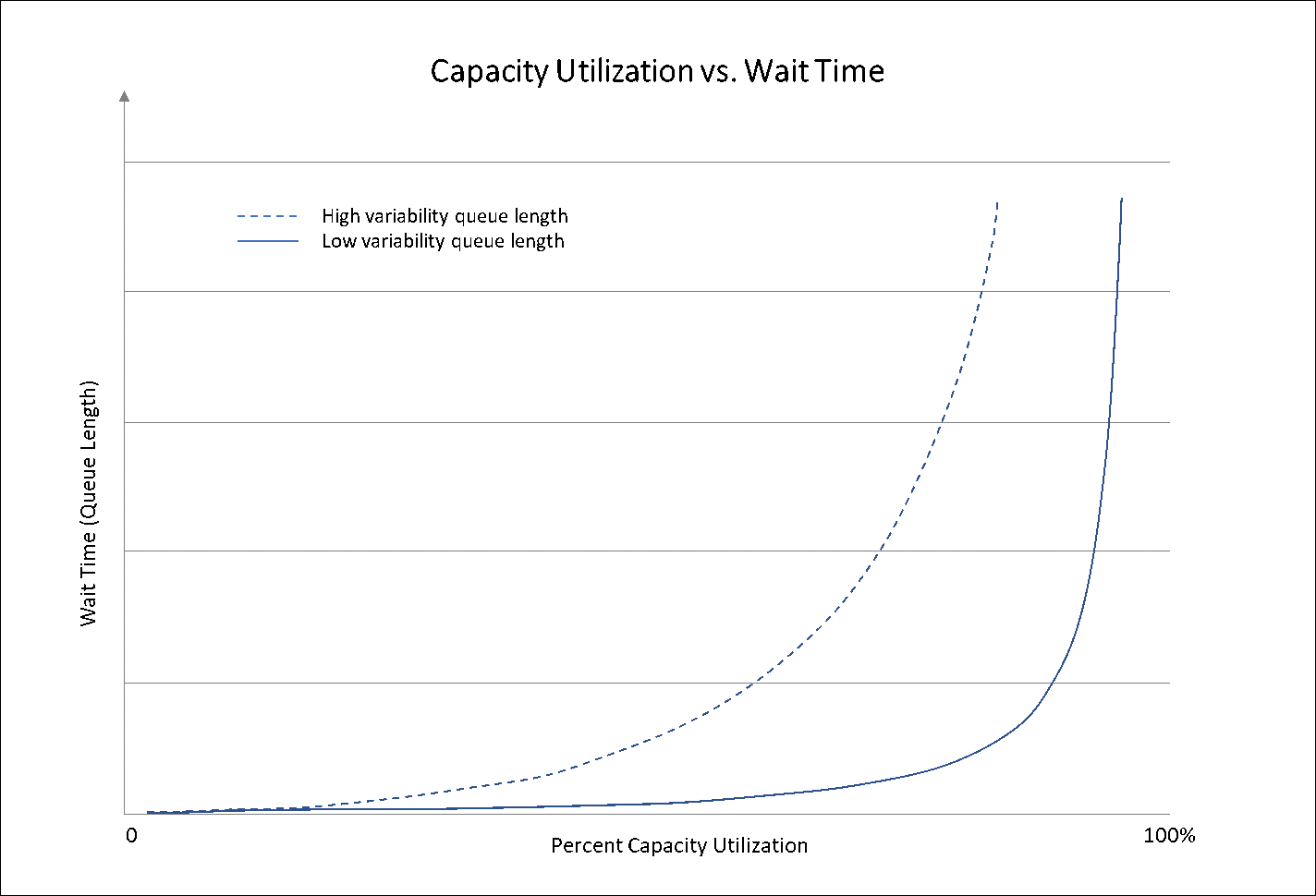
Fig. 1: Wait times rise exponentially as percent capacity utilization approaches maximum levels. The impact is significantly greater for high-variability activities often found in knowledge work such as Product Development.
At the heart of modeling a Product Development system is queuing theory. At its core, queuing theory studies how work flows through a system – whether it’s serving coffee at a Starbucks, answering calls at a customer support center, or performing product development tasks in a project pipeline. In all cases, as capacity utilization increases, wait times also increase. The key insight is striking: as utilization approaches maximum capacity, wait times don’t just grow – they skyrocket exponentially. And for high-variability activities found in knowledge work, such as creating a marketing plan or developing a prototype, this phenomenon occurs at a lower capacity utilization point. This is why chasing maximum utilization introduces delays that actually harm your business.
And Product Development inherently has a high level of variance in all its tasks, in all departments. This is not a deterministic process with low variability in the duration of each task, of each activity. So, applying the mathematics of queueing theory, it’s easy to demonstrate the impact of system loading, of uncoordinated on-ramps and off-ramps, of missed or delayed deliverables. Just like on-ramp signals on major freeways, and variable speed limit signs on, for example, the M25 in London, all are backed by the science of queueing theory that demonstrates that going at the appropriate speed, not the fastest speed, actually increases overall throughput of the system. And trying to push more down the road faster results in large, uncontrolled, and unanticipated delays.
Conclusion
What is the status of your development process? Are your products on time to market? Are there bottlenecks, chokepoints, or delays in your process? Do your product development teams find ever-expanding chaotic situations to overcome? Are there a lot of redesign efforts? How much energy are your teams expending to thwart sub-optimizations that occur on a regular basis? Is your Product Development System in balance, or severely overwhelmed?
It is imperative for leaders to recognize the impact of overloading the system. Are you of the mindset “You can’t go fast unless your foot is on the gas?” Complex Product Development is a system of interrelated and interdependent tasks and deliverables. As a result of trying to push inappropriately fast – of not having the right people engaged at the right time, of not having the discipline of doing the right activity at the right time, of not making a decision on the right things at the responsible moment – all of these can lead to missed milestones, lower quality output, and project delays. The key to success is to focus on understanding, creating, and optimizing the flow in your Product Development system. When you’re in the midst of the battle called complex Product Development, smooth is fast.
Organization News Page

Questions;
Are your products on time to market? How do you identify bottlenecks, chokepoints, or delays in your process?
What great ways have you explored in guiding knowledge workers to focus on high-value activities?
Join the conversation at our LinkedIn group!
Group Discussion Page

Dan Caputo
Dan Caputo is a strategist, systems thinker, and innovation champion with over 35 years developing and bringing new products to market. He has extensive experience in leading technology asset and product development teams, and has been using Lean Product Development principles to simultaneously drive product innovation and program excellence.