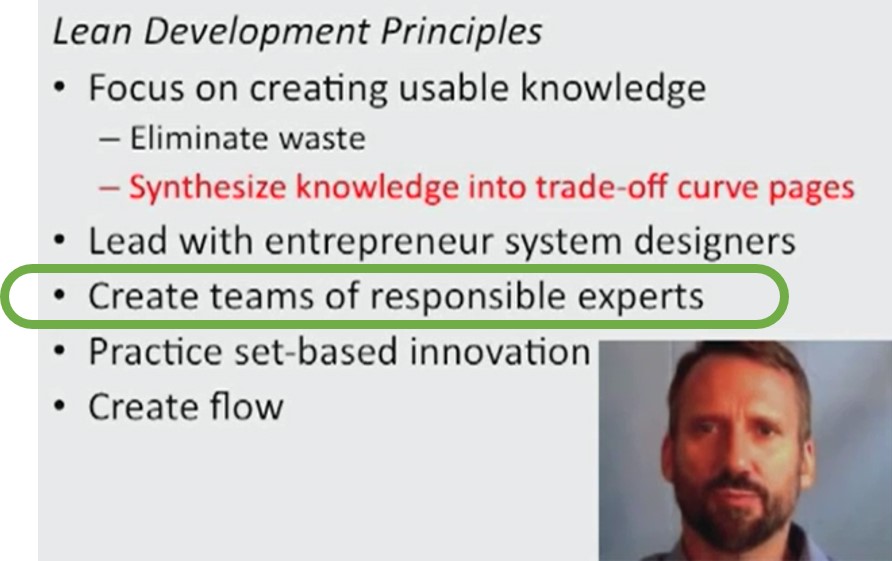
One of the fundamental principles of Lean Product and Process Development is “Create teams of responsible experts”. It is about creating teams with a common responsibility, at the same time as each individual is striving to “tower her own competence”. The team strives for perfection in their common mission, and each team member strives for perfection in their own expert area.
Focus on the need for experts
Towering technical competence begins with the system a company uses to hire, develop, and retain experts. Many companies, unfortunately, do not have a system or philosophy that support this. They might even believe it is a waste to invest in the employees training, particularly in Western companies with a high turnover rate of engineers. What these companies fail to appreciate is the need of a system that develops knowledgeable engineers thus nurturing a vibrant lean PPD culture. The paradox is that if you have a high turnover rate of engineers you need to work even harder to retain the experts and to document their knowledge.
What about the managers responsibility? Being a leader in a lean PPD organization also means being a teacher and coach. Within a learning organization, a primary responsibility for managers is technical mentoring of new engineers as well as challenging the deep experts to grow their knowledge.
To enable an efficient way to capture knowledge and to do it as a coach, Allen Ward developed LAMDA:

When you go to the lab (go to gemba) you:
Look – What do you see
Ask – Ask questions to understand
Model – Visualize hypothesis
Discuss – Discuss with all experts
Act – Run the experiment and learn
Building teams
Building strong teams of technical experts requires that they have a clear purpose and goal. Thereafter you define the different knowledge areas needed and recruit suitable experts.
Start building the teamwork skills to achieve a high performing team where every member will strive to achieve the objective of the mission. It doesn´t matter if it is defined as a “personal” responsibility to make a certain task, if it is needed, we will do it.
A good example is the surgical team performing an operation. A successful operation requires a team of very skilled doctors and nurses. They have a common goal and work together in real-time. No time to check the manual for whom is responsible if something unplanned happens.

On a personal level the expert should “love her area of expertise” and strive after being the very best in the world! To support this, it is advisable to have an expert career path with clear expert levels to excel in the talent-driven expert creation. If you don´t have this alternative there is a risk you will lose good experts to a traditional management career, and in the worst case end up with a lousy manager.
Apart from the technical capability of each team member, the team need to have creative problem-solving ability (thinking outside the box) and skills on teamwork as well as the ability to “grasp situation” quickly, thoroughly, and at a detailed level (what to look for, questions to ask, know what you need to learn and understand).
The quote “We develop people and new products simultaneously using the Toyota way” is acclaimed Uchi Okamota, former Vice President, N.A. Body and Structures Engineering, is an example how Toyota sees the topic of knowledge development. This mindset creates a great environment to develop responsible experts.
Capturing usable knowledge

Knowledge books are always been seen as central to build knowledge. Today they are many times replaced by digital solutions as well as using AI as it evolves. The most important part is that you capture the usable knowledge. The most visible way to capture the knowledge is creating graphs, like trade off curves and limit curves comparing different customer interests.
Strive for perfection
Striving for perfection by towering your own competence to become the best in the world in your special area requires a special mindset and several sub-principles;
-
- Deep technical expertise from academic learning as well as practical learning of their field. This involves continuous learning and staying updated with the latest advancements in technology and engineering practices.
- The ability to learn faster than the competitors is valid as a mindset also for the individual.
- Experienced engineers should mentor less experienced ones, provide guidance and share their knowledge. This helps in building a strong foundation and transferring valuable skills.
- Hands-on experience is crucial for developing your competence, working on real-world projects and gain hands-on experience.
- Collaborating and working in teams helps sharing knowledge, testing hypothesis and solving complex problems more effectively. Teamwork fosters the culture of learning and innovation.
Continuous improvement is always a vital part - challenge, test through hypothesis and learn fast. This enables experts to continue learning and deepening their knowledge.
Conclusion
As usual with Lean Product and Process Development you need to have a system in place, and in this case even a sub-system. If you want to create teams of responsible experts - who strive for perfection you need to find the best, develop them and keep them. What would be the key challenges to succeed? Salary? Possibility to deepen their knowledge? Autonomy? Possibility to share the knowledge inside the company? and outside like academia or why not LPPDE events? Ask yourself do we have the best experts? and are they striving for perfection?
Questions;
Are you developing and challenging your knowledge workers in a good way? Do you have a clear expert career path? Does your experts strive for perfection? Is their knowledge make you market leader?
Do you have a world class system to build the knowledge you need fast enough?
Join the conversation at our LinkedIn group!

Peter Palmér
Senior Transformation Strategist at TRATON
Peter Palmér has extensive experience in lean management in both production and product development, as well as experience of leadership in other cultures. With 18 years of experience within production, engineering and quality followed by 20 years in various management positions in product development Peter has many stories to tell. Since the beginning of the 1990es he has been closely involved with the Scania Way development journey both in Sweden and South America.
Peter is a frequent speaker at international and national conferences on the subject of LPD and leadership. Peter has been working closely with LPPDE since the organization's start 2008 including seven years on the LPPDE board with a second period started 2023. Through LPPDE Peter has organized and chaired or co-chaired many conferences in Europe and in the US. Since the end of 2020 he runs the monthly LPPDE Virtual Summits, a three-hour learning exchange with three different speakers. He is a member of various LPD-networks and has co-developed LPD training courses with Chalmers Professional Education and The KTH Royal Institute of Technology.
