
Picture this: you’re building a smartphone, and your team’s split between two camps. One’s clutching a Gantt chart–detailed to task level–like it’s the Holy Grail, demanding every resistor be approved before the next phase gate. The other’s writing ideas on napkins, prototyping bread-boards in the lab, and asking, “What if we just try it?” Welcome to the two super paradigms of product development: Process Compliance and Knowledge-Based. With 20 years of scars from Lean and open-minded product battles, I’m here to strip these paradigms to their first principles*, toss in some examples, and explain why many enterprises need to ditch the clipboards for a bit of creative chaos.
Let’s start with Process Compliance
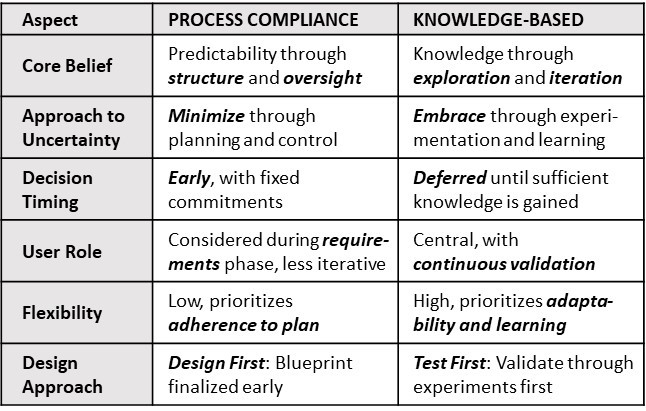
This paradigm is like your uncle who insists on assembling IKEA furniture strictly by the manual, even when the screws don’t fit. It’s built on the first principle that product development is a predictable beast, tamed by breaking it into neat, sequential phases — concept, design, build, test, launch. At gates between each it demands deliverables, approvals, and a slide deck thicker than a phone book. The core belief? Structure equals success. By standardizing processes, enforcing oversight, and marching linearly, you minimize risk and ensure consistency. Another principle is that risks are predictable and caught early through gate reviews, like a teacher checking your homework before recess. And let’s not forget the design-first mindset: nail the blueprint upfront, because changing plans mid-build is like rewriting a novel after it’s printed.
The benefits? Oh, they’re real. Process Compliance is the comfort food of development—predictable, scalable, and stakeholder-friendly. In industries like aircraft or pharmaceuticals, where a single misstep could crash a plane or a clinical trial, this rigidity saves lives and budgets. It’s why Airbus and Pfizer sleep better at night. But here’s the rub: jokingly, it's slower than a sloth on Valium. When I once worked on a car electric drive train. We spent six months perfecting requirements. Only to learn on the test that what the customer wanted, was incompatible with the laws of thermodynamics. The linear approach assumes you can know everything upfront, which, in today’s fast-moving markets, is like planning a picnic during a hurricane. It stifles innovation when teams are too busy ticking boxes to question if the box even makes sense.
Now, enter Knowledge-Based
This paradigm does not trust phase gates and says, “Let’s learn before we leap.” Its first principle is that knowledge precedes commitment—you don’t design until you’ve explored, prototyped, and tested hypotheses. Imagine a restaurant chef refusing to write a menu until they’ve tasted the ingredients. Iteration is king here; each cycle of build-test-learn refines the product, like sculpting a statue by chipping away at marble. It’s test-first, not design-first—think of coding test-driven development, where you write the test before the code, ensuring you’re solving the right problem. Another principle? Uncertainty is your dance partner. Instead of fighting unknowns, you embrace them through experiments, user feedback, and pivots. I once saw a startup pivot from a monitoring-smart-sensor to offering a tamper-proofing-setup-sensor after user tests showed tinny value in monitoring data collected.
The benefits of Knowledge-Based are juicy: faster innovation, better customer fit, and less rework. In tech, companies like Spotify thrive by iterating playlists based on user data, not committee approvals. But it’s not all roses. This approach demands skilled teams who can handle ambiguity without crying into their coffee. It’s chaotic, like herding cats on Red Bull, and stakeholders accustomed to Gantt charts might clutch their pearls when you say, “We’ll figure out the timeline after three subset prototypes.” In regulated industries, aligning iteration with compliance, is like teaching a dinosaur to tap dance.
Here’s a matrix to sum it up, straight from first principles:
So, why do so many enterprises stick with Process Compliance like it’s a security blanket? It’s the safe bet—predictable, accountable, and stakeholder-friendly. But in a world where customers change their minds faster than a toddler in a toy store, this rigidity can doom you to building yesterday’s products. Knowledge-Based, with its test-first, iterative swagger, unlocks innovation by letting teams learn what customers actually want. I led the development of power electronics for a new company where neither we nor our customers had any requirements specifications. The customers were stuck in a phase-gating process. When I started a knowledge-based pilot project, with rapid prototyping and feedback from customer testing. Where we discovered that customers only needed half as much power under real-world conditions. Uncovering a huge upside. That success became the starting point for our transformation, to continue iterating like an F1 pit stop team.
The challenge?
Shifting to Knowledge-Based requires cultural surgery—training teams, soothing stakeholders, and proving iteration doesn’t mean anarchy. But the payoff is worth it. Enterprises that embrace this paradigm innovate faster, adapt to market shifts, and avoid building products nobody wants. It’s not about abandoning structure entirely; it’s about swapping the straitjacket for a stretchy yoga outfit. So, ditch the Gantt chart, grab a napkin, and start exploring. Your next big idea might just thank you.
* First principles thinking is an approach stripping away assumptions and conventions to identify the core and irreducible elements. Here first principles are the foundational truths that must hold true for the two paradigms to function, independent of context or implementation.
Organization News Page

Questions;
What’s the most absurd phase-gate hoop you’ve had to jump through in a product development project, and how could a Knowledge-Based approach have saved the day?
If you could sneak one iterative, test-first experiment into your company’s process-heavy playbook, what would you try, and why?
Join the conversation at our LinkedIn group!
Group Discussion Page

Christer Lundh
Funder & President of AUFERO
With 25 years of senior leadership experience and two decades mastering Lean product development, Christer Lundh is a force of innovation and efficiency. As an entrepreneur, he built a thriving Lean startup from the ground up, proving that direction, problem-solving, and flow are not just theories—they’re the foundation of success. A champion of change and a strategist at heart, Christer transforms complexity into clarity, guiding teams and organizations to peak performance. Today, he brings invaluable insights on leadership, entrepreneurship, and the power of Lean thinking to help you navigate change and drive results.